We've got very preliminary evidence that supports what Evelyn is saying. Cool, huh? The message that dieting is associated with weight gain is a great example of why my work here at Otago, looking at weight gain prevention, is so important...we've got a fair amount of women who maintained weight over 3 years without controlling weight through dieting. How did they do it? We'll see!
Showing posts with label Research. Show all posts
Showing posts with label Research. Show all posts
Monday, January 21, 2013
Ditch the Dieting!
Evelyn Tribole is very enthusiastic about getting the word out that dieting doesn't lead to permanent weight loss. Here's a clip of Evelyn getting her message out:


Sunday, January 20, 2013
"Why am I 'a beast'?"
Lately, I've been spending a lot of free time reading through parent interviews to look for themes related to their acceptance of the message that their child is overweight (based on body mass index). I really enjoy reading through the transcripts! It's been a fantastic learning experience for me to read how parents reacted in so many different ways.
One question every parent was asked is: "Did you share the health check information with your child?" Then the parent is asked to explain the decision around that (keep in mind the children are between age 4 and 8).
One mother used the information to explain to her child that a healthy lifestyle is important so that the child doesn't get fat like Violet in Charlie and the Chocolate Factory; if that happened, the ooompa loompas would take him away!
<iframe allowfullscreen="" frameborder="0" height="270" src="http://www.youtube.com/embed/Z4_cf_fZDc0" width="480"></iframe>
Another mother told the child that the results say she is obese. The child's response was, "Why am I 'a beast'?"
I think it can be a tough conversation to have with a child - explaining why adults are measuring around their tummy, checking their height and weight, and then trying to explain what those measurements mean so the child understands. Clearly, some children are too young to understand the body mass index labels.
It appears that there are parents who don't want to share weight-related information with their child because they're concerned that the child will develop weight/body image/self-esteem issues. Well, we've got inquisitive kids in the study and they want to know what's going on. So, instead of focusing on body weight, the parents explain that the study is looking at what the family eats and how active the family is and go on to drive the point home that it's important to look at the big picture of what a healthy lifestyle is all about. (Interestingly, some children have been very accepting that they are overweight and it means that the family needs to think about eating less, choosing healthier foods and getting more active. The key has been including the child in how they'll eat differently or be more active - they love making decisions for themselves!)
So, I've asked myself, Why is it okay for adults to take the focus off of body weight for children and instead focus on an overall healthy lifestyle, but often adults find it okay to focus on body weight instead of factors that contribute to a healthy lifestyle?
Why can't we all realize that we should be making choices because we believe we'll be healthier (and, hell, happier?!) as a result, not because we want to control our weight?
I'm very thankful that I've been a part of this portion of the study. It's made me think long and hard about how I envision our weight gain prevention intervention because I've been concerned that adults won't participate if they aren't losing weight - even if they do end up making healthier lifestyle choices as a result!
For the psychology fans out there... I attended an Acceptance and Commitment Therapy workshop with Steven Hayes before I arrived in New Zealand. During one session, each of us closed our eyes and envisioned a conversation that we would have with a younger version of ourselves. Why? Adults are generally more compassionate towards children. So, the idea is to think of a situation, say, the time my pediatrician told my mom that I could stand to eat a few more salads. Then I'd visualize the conversation that I'd have with that 8-year-old Sara: "Yeah, you're overweight and 20 years from now you'll be considered 'overweight' and that's okay. You'll spend a long, long time being frustrated by your weight, but you'll do your best to make choices that support your health. You'll finish an IRONMAN! You'll be healthy and happy because you don't obsess about becoming skinny. In fact, you'll go on to pursue a PhD because of that conversation between your mom and your doctor - you'll study how to teach women how to listen to their own hunger and satiety cues; how cool is that?!"
My hope is that some day we'll all realize that it's not someone's excessive body weight that's a problem, it's the behaviors that lead to excessive body weight that should be addressed. (One overweight boy sought approval from his dad by eating five apples in a day because they're 'healthy', but the boy doesn't understand that even too much of a healthy food can have an impact on his health/how he feels-making him aware of that would be important!).
Also, I think reassuring people that it's a process to make healthier choices is super important, too. There are just too many uncontrollable things in life to expect a huge change that leads to a huge impact overnight...
Seems like I've got my work cut out for me with my intervention!
One question every parent was asked is: "Did you share the health check information with your child?" Then the parent is asked to explain the decision around that (keep in mind the children are between age 4 and 8).
One mother used the information to explain to her child that a healthy lifestyle is important so that the child doesn't get fat like Violet in Charlie and the Chocolate Factory; if that happened, the ooompa loompas would take him away!
<iframe allowfullscreen="" frameborder="0" height="270" src="http://www.youtube.com/embed/Z4_cf_fZDc0" width="480"></iframe>
Another mother told the child that the results say she is obese. The child's response was, "Why am I 'a beast'?"
I think it can be a tough conversation to have with a child - explaining why adults are measuring around their tummy, checking their height and weight, and then trying to explain what those measurements mean so the child understands. Clearly, some children are too young to understand the body mass index labels.
It appears that there are parents who don't want to share weight-related information with their child because they're concerned that the child will develop weight/body image/self-esteem issues. Well, we've got inquisitive kids in the study and they want to know what's going on. So, instead of focusing on body weight, the parents explain that the study is looking at what the family eats and how active the family is and go on to drive the point home that it's important to look at the big picture of what a healthy lifestyle is all about. (Interestingly, some children have been very accepting that they are overweight and it means that the family needs to think about eating less, choosing healthier foods and getting more active. The key has been including the child in how they'll eat differently or be more active - they love making decisions for themselves!)
So, I've asked myself, Why is it okay for adults to take the focus off of body weight for children and instead focus on an overall healthy lifestyle, but often adults find it okay to focus on body weight instead of factors that contribute to a healthy lifestyle?
Why can't we all realize that we should be making choices because we believe we'll be healthier (and, hell, happier?!) as a result, not because we want to control our weight?
I'm very thankful that I've been a part of this portion of the study. It's made me think long and hard about how I envision our weight gain prevention intervention because I've been concerned that adults won't participate if they aren't losing weight - even if they do end up making healthier lifestyle choices as a result!
For the psychology fans out there... I attended an Acceptance and Commitment Therapy workshop with Steven Hayes before I arrived in New Zealand. During one session, each of us closed our eyes and envisioned a conversation that we would have with a younger version of ourselves. Why? Adults are generally more compassionate towards children. So, the idea is to think of a situation, say, the time my pediatrician told my mom that I could stand to eat a few more salads. Then I'd visualize the conversation that I'd have with that 8-year-old Sara: "Yeah, you're overweight and 20 years from now you'll be considered 'overweight' and that's okay. You'll spend a long, long time being frustrated by your weight, but you'll do your best to make choices that support your health. You'll finish an IRONMAN! You'll be healthy and happy because you don't obsess about becoming skinny. In fact, you'll go on to pursue a PhD because of that conversation between your mom and your doctor - you'll study how to teach women how to listen to their own hunger and satiety cues; how cool is that?!"
My hope is that some day we'll all realize that it's not someone's excessive body weight that's a problem, it's the behaviors that lead to excessive body weight that should be addressed. (One overweight boy sought approval from his dad by eating five apples in a day because they're 'healthy', but the boy doesn't understand that even too much of a healthy food can have an impact on his health/how he feels-making him aware of that would be important!).
Also, I think reassuring people that it's a process to make healthier choices is super important, too. There are just too many uncontrollable things in life to expect a huge change that leads to a huge impact overnight...
Seems like I've got my work cut out for me with my intervention!
Thursday, December 27, 2012
Science + Hooker Valley = PhD Fun. Part 2
There are two kinds of PhD research topics.
The first kind involves doing really cool stuff to collect data, but the rest of the research is either very boring or, and this seems to be the case more often than not, others may feign interest in the topic yet only vaguely understand why the research is being done.
Take my friend Rob, for example. He likes things that explode - volcanoes to be exact. This guy has been all over the map to do volcano-y research that, I think, involves some fancy pants math stuff. But, I don't care what makes these things go kaboom - I'm interested in the pictures of the places he's visited to study the kaboom.
Take my friend Rob, for example. He likes things that explode - volcanoes to be exact. This guy has been all over the map to do volcano-y research that, I think, involves some fancy pants math stuff. But, I don't care what makes these things go kaboom - I'm interested in the pictures of the places he's visited to study the kaboom.
The other kind of research is like my own; collecting the data is as exciting as watching paint dry, but most people will understand and have an opinion on the results.
I've been to a handful of parties where no one cares that I sent out a few thousand questionnaires and then sat around for 3 months waiting for them to be returned, but people do care to hear that our results suggest this, this and this about predictors of weight gain/weight stability and they have a related personal story to share.
Well, it just so happens that my friend Mandy is one of those lucky ducks who gets to travel for her research. She takes samples of water from various ponds (and has even had people from overseas send her water samples!) and then looks for things in them.
Last week, we went on a little road trip and she pointed out some of her ponds.

Here's one:

Mandy has to walk around the water and scoop up samples with a net. Here's an example of what she takes back to the lab at the end of the day:

Just an hour from the Kettleholes was our destination - Mt. Cook (the highest mountain in New Zealand and called Aoraki a.k.a. "Could Piercer" by the Maori).
We could see Mt. Cook really well from a lookout on Lake Pukaki.

We wanted to get a closer look at Mt. Cook and so we took a walk on the Hooker Valley track (roughly 4k to the Hooker glacier). Mandy loved the bridges that we crossed.

Getting closer...

We made it to the glacier! There were giant chunks of ice floating in the lake, but I am a lump head and didn't take a video of them bobbing and rolling around.

I've been to a handful of parties where no one cares that I sent out a few thousand questionnaires and then sat around for 3 months waiting for them to be returned, but people do care to hear that our results suggest this, this and this about predictors of weight gain/weight stability and they have a related personal story to share.
Well, it just so happens that my friend Mandy is one of those lucky ducks who gets to travel for her research. She takes samples of water from various ponds (and has even had people from overseas send her water samples!) and then looks for things in them.
Last week, we went on a little road trip and she pointed out some of her ponds.

Here's one:

Mandy has to walk around the water and scoop up samples with a net. Here's an example of what she takes back to the lab at the end of the day:

Just an hour from the Kettleholes was our destination - Mt. Cook (the highest mountain in New Zealand and called Aoraki a.k.a. "Could Piercer" by the Maori).
We could see Mt. Cook really well from a lookout on Lake Pukaki.

We wanted to get a closer look at Mt. Cook and so we took a walk on the Hooker Valley track (roughly 4k to the Hooker glacier). Mandy loved the bridges that we crossed.

Getting closer...

We made it to the glacier! There were giant chunks of ice floating in the lake, but I am a lump head and didn't take a video of them bobbing and rolling around.

I really recommend this track. It was soooo cheesy easy to walk because it was pretty flat and it was very accessible. Just be warned that in the summer it gets very busy. With that said, I'd definitely do the ~ 2 hour walk again. *hint, hint to friends and family*
Monday, November 19, 2012
Weight ("Mis")Management
I had an incredible weekend: the kind where it was so simple and so relaxing that I have hope it can happen again and again and again and...
The best part is that I've been able to start my Monday off with the most clarity that my mind has had in a very, very long time. It's a great feeling to sit down at my computer and have a refreshed sense of being and wanting to really dig in to my research rather than just peck words into Google and hit "search" and calling it "work".
Today, I am reading an Acceptance and Commitment Therapy for diabetes self-management therapist manual by Jennifer Gregg, Steven Hayes and Glenn Callaghan. I only got a few paragraphs into the background before my mind started going off on tangents about why it's so damn difficult to control the behavior that affects our health.
So, being the visual person that I am, I started playing around with trying to put it into picture form.

I have a hunch that helping the individual learn to take a hot second to assess the present moment and act in a way that they nod to what they value is sooo crucial. But, it's not enough.
It's tough to battle all those forces (on the right side of that picture above, plus all the ones that are missing) day after day after day by yourself. It doesn't have to be/feel that way, though. Social support is great. Having a friend or family member that values healthy living can be great motivation to make decisions and carry them out so that the outcome leads to weight management (a.k.a. health maintenance/improvement). Yet, I don't think it's enough support for entire populations on a quest to be healthier. I truly believe that we need to tackle the factors related to climbing obesity rates from many directions. For example, making cheap, tasty foods less available (do you ever walk around and notice how readily available food is?!) or downsizing food packaging.
That last part, downsizing food packaging, has never been more obvious to me than now. Living in New Zealand has been GREAT for observing differences between here and the United States. The availability of foods in large packages is so much less common here. I think that if the large package sizes of common foods (like peanut butter) were available in the large jars that we see at home then New Zealand's prevalence of obesity would match the U.S.
Now, ain't that food for thought?
*Acceptance and Commitment Therapy researchers have suggested that people avoid their overwhelming thoughts rather than accept them as thoughts. When it comes to eating behavior, we may avoid our overwhelming thoughts/cope with these thoughts by eating. In a culture where food is tasty, cheap and readily available it is no wonder how easily we can self-medicate with food; but, rather than overdosing and facing instant death, it's a slow process that leads to high blood pressure, diabetes, cancer and all sorts of problems that we don't see until we're further down the road. Deciding, now, what we value may help us change our course of behavior when we have thoughts that conflict with our values. Cool stuff, eh?
The best part is that I've been able to start my Monday off with the most clarity that my mind has had in a very, very long time. It's a great feeling to sit down at my computer and have a refreshed sense of being and wanting to really dig in to my research rather than just peck words into Google and hit "search" and calling it "work".
Today, I am reading an Acceptance and Commitment Therapy for diabetes self-management therapist manual by Jennifer Gregg, Steven Hayes and Glenn Callaghan. I only got a few paragraphs into the background before my mind started going off on tangents about why it's so damn difficult to control the behavior that affects our health.
So, being the visual person that I am, I started playing around with trying to put it into picture form.

Basically, I started thinking about the typical weight loss program. The participant is told "Eat less. Exercise more." Easy enough, right? Ehhhh, well...
What you see in this picture is that I made a rectangle and split it exactly in half. On the left side, I plopped in two hexagons to represent the diet and exercise that an individual must focus on inorder to have the desired effect on their weight. I had plenty of room to type a note to myself and have a representation of diet, exercise and the individual.
But, then I wanted to see a more accurate picture of what a typical person is dealing with because it's unfair to assume that anyone can devote all of their attention to just trying to lose weight or maintain weight. I didn't have enough room to squish in all those factors that influence our ability to manage weight... in fact, the circle that is labeled "individual" (ironically) is being pushed out of the picture!
Oooooh! Ahhhhh!!!
So, here's what I'm thinking:
As we look at factors influencing an individual's ability to manage weight, we see that when we look closer there are so many things that the individual gets crowded out! *ACT/IE can help put the individual at center of their own life. It gives them a point of view where they can handle things as they come rather than being overwhelmed. Skills learned can help a person not only moment-by-moment, but also help them plan for the future.Over the next few weeks, months, years I'll work hard to keep in mind that weight management isn't simple. With that in mind, I need to help come up with a simple way to help people with a complicated issue. Otherwise, it won't work. Bariatric surgery, diet pills, and fad diets are "easy" solutions, but they come with nasty side effects.
I have a hunch that helping the individual learn to take a hot second to assess the present moment and act in a way that they nod to what they value is sooo crucial. But, it's not enough.
It's tough to battle all those forces (on the right side of that picture above, plus all the ones that are missing) day after day after day by yourself. It doesn't have to be/feel that way, though. Social support is great. Having a friend or family member that values healthy living can be great motivation to make decisions and carry them out so that the outcome leads to weight management (a.k.a. health maintenance/improvement). Yet, I don't think it's enough support for entire populations on a quest to be healthier. I truly believe that we need to tackle the factors related to climbing obesity rates from many directions. For example, making cheap, tasty foods less available (do you ever walk around and notice how readily available food is?!) or downsizing food packaging.
That last part, downsizing food packaging, has never been more obvious to me than now. Living in New Zealand has been GREAT for observing differences between here and the United States. The availability of foods in large packages is so much less common here. I think that if the large package sizes of common foods (like peanut butter) were available in the large jars that we see at home then New Zealand's prevalence of obesity would match the U.S.
Now, ain't that food for thought?
*Acceptance and Commitment Therapy researchers have suggested that people avoid their overwhelming thoughts rather than accept them as thoughts. When it comes to eating behavior, we may avoid our overwhelming thoughts/cope with these thoughts by eating. In a culture where food is tasty, cheap and readily available it is no wonder how easily we can self-medicate with food; but, rather than overdosing and facing instant death, it's a slow process that leads to high blood pressure, diabetes, cancer and all sorts of problems that we don't see until we're further down the road. Deciding, now, what we value may help us change our course of behavior when we have thoughts that conflict with our values. Cool stuff, eh?
Thursday, November 15, 2012
Jean Kristeller, Ph.D "Mindfulness Based Eating"
Mindfulness-based eating... can it help with weight maintenance? There's potential to incorporate bits of Dr. Kristeller's work into my intervention. Cool, eh?
Thursday, October 18, 2012
A.I.M. for Health
I've been doing so much searching, reading, and typing lately! A lot of it has been related to weight gain prevention interventions and Internet-based obesity prevention interventions. So, it doesn't feel like work to me - I really love reading this stuff.
I'm so excited about doing an intervention that I've started to play around with plopping bits and pieces of others' research onto a free website to get ideas of what my intervention could look like. In fact, I spent about 2 hours chatting online with an IT guy named "Paul" as we worked together to figure out how to get Tylka's Intuitive Eating Scale onto the site and have it scored correctly.
Poor Paul.
I was having issues. Lots and lots of issues. I think this image sums up how helpful Paul was when I couldn't find the "+" button to add the test that I made out of Tylka's questionnaire:

I'm not entirely sure if I'll develop the site or if we'll get a sweet grant to pay for a developer, but it's still fun to take breaks from acceptance/intuitive eating/mindfulness literature searches to do something which has a more tangible output.
Yesterday, I met with a researcher at Otago who's running an Internet-based depression intervention. She was great fun to talk to because she's knowledgeable about the process of testing content for the intervention, working with a web developer, recruiting participants and so on. She got me really excited for what I could do down the road! She also got me thinking about all the work involved: running focus groups to discuss Internet-based weight gain prevention interventions, developing content, locating experts in the field to review the content, developing the website for the intervention, testing the content with a sample from the target population, etcetera.
But, I have a bad habit of putting the cart before the horse. Or, in this case, the intervention before the data to back up the intervention. *sigh* This means I actually need to sit my rump down, re-introduce myself to Stata, and run an analysis or two...or three... to figure out if our hypotheses about intuitive eating, experiential avoidance, psychological inflexibility, and mindfulness hold water (a.k.a. justify targeting these predictors of weight gain in an intervention). *fingers crossed* With some luck (or, a visit from the Motivation Fairy) I will get around to this very, very soon.
I'm so excited about doing an intervention that I've started to play around with plopping bits and pieces of others' research onto a free website to get ideas of what my intervention could look like. In fact, I spent about 2 hours chatting online with an IT guy named "Paul" as we worked together to figure out how to get Tylka's Intuitive Eating Scale onto the site and have it scored correctly.
Poor Paul.
I was having issues. Lots and lots of issues. I think this image sums up how helpful Paul was when I couldn't find the "+" button to add the test that I made out of Tylka's questionnaire:
I'm not entirely sure if I'll develop the site or if we'll get a sweet grant to pay for a developer, but it's still fun to take breaks from acceptance/intuitive eating/mindfulness literature searches to do something which has a more tangible output.
Yesterday, I met with a researcher at Otago who's running an Internet-based depression intervention. She was great fun to talk to because she's knowledgeable about the process of testing content for the intervention, working with a web developer, recruiting participants and so on. She got me really excited for what I could do down the road! She also got me thinking about all the work involved: running focus groups to discuss Internet-based weight gain prevention interventions, developing content, locating experts in the field to review the content, developing the website for the intervention, testing the content with a sample from the target population, etcetera.
But, I have a bad habit of putting the cart before the horse. Or, in this case, the intervention before the data to back up the intervention. *sigh* This means I actually need to sit my rump down, re-introduce myself to Stata, and run an analysis or two...or three... to figure out if our hypotheses about intuitive eating, experiential avoidance, psychological inflexibility, and mindfulness hold water (a.k.a. justify targeting these predictors of weight gain in an intervention). *fingers crossed* With some luck (or, a visit from the Motivation Fairy) I will get around to this very, very soon.
RESEARCH IS FUN!
Wednesday, October 10, 2012
6-Month PhD Progress Report
Today, I met with both supervisors and a convener to discuss my progress. The meeting didn't start so well because my computer wasn't connecting to our network printer, which meant I didn't have copies of my self-report and I forgot the document that we were supposed to sit down and fill in together. Oops!
My supervisors said that my progress so far is "fair" - just above "unsatisfactory" and just below "good". I'm definitely disappointed in myself. I've borrowed $25,000 to fund this year's tuition and living expenses, moved away from family and friends to live on the other side of the world, and allowed relationships to fall apart to pursue this PhD. No one wants to be told her progress is only "fair" after all that! But, the bright side is that I still have 2.5 years to get my act together and get some awesome stuff done.
To date, I've survived my first nationwide mailed survey of mid-age New Zealand women: the 3-year survey is complete. We had just over 1,000 respondents and our response rate was just shy of 80%. Also, the intervention development is in its infancy. We've begun analyzing the predictors of weight gain to target in the intervention; I began looking into the pros and cons of using a free program where I'm in charge of content and design versus using a web developer for creating the intervention website; and, I've contacted researchers who've shared materials from their interventions with me so that I can possibly adapt their content for my intervention. So, I'm happy with what I've done so far.
Aside from the research, a noticeable theme to my blog topics has been tramping. I think this is where people get the impression that I'm having too much fun and, hence, why my progress is only fair. But, if that is the case, so be it! New Zealand is too beautiful to leave unexplored. If my progress has been hindered by hiking majestic mountains then I will happily accept ho-hum reviews! I still can't get over the breathtaking landscapes here. Even on a clear night, I've found myself looking up and thinking Wow, this is amazing! How'd I get so lucky to be here?! I'd be a fool if I allowed myself to be chained to my desk 24/7 when I can be doing this:

What are my plans for the future? Well, for starters, I better get plugging away on that intervention! I will also finish a manuscript that I started back in...March. Then, maybe writing up a thesis chapter or two should go on my "to do" list, and, heck, sitting down to analyze our 3-year data some more wouldn't be so bad, right? So, it's been a combination of needing to get all this work done plus simply not being ready to go back to New York, for a variety of reasons, that I've decided to put off a trip home. I think I'll be in a better position to try for a visit some time in July.
Many thanks to everyone who helped me get this far into my PhD journey - my supervisors who have reassured me that my quantity and quality of work will keep on improving, my friends who have reminded me that I'm missed (particularly the ones who've taken time out of their busy lives to send me warm loving from home - a.k.a. cards and care packages), and my family who have reminded me that I'm not only missed, but loved a whole bunch. My mom, in particular, has been a pillar of strength and a beacon of hope.
Now that I'm fired up, I better redirect my energy into thesis-related business rather than venting. ☺
My supervisors said that my progress so far is "fair" - just above "unsatisfactory" and just below "good". I'm definitely disappointed in myself. I've borrowed $25,000 to fund this year's tuition and living expenses, moved away from family and friends to live on the other side of the world, and allowed relationships to fall apart to pursue this PhD. No one wants to be told her progress is only "fair" after all that! But, the bright side is that I still have 2.5 years to get my act together and get some awesome stuff done.
To date, I've survived my first nationwide mailed survey of mid-age New Zealand women: the 3-year survey is complete. We had just over 1,000 respondents and our response rate was just shy of 80%. Also, the intervention development is in its infancy. We've begun analyzing the predictors of weight gain to target in the intervention; I began looking into the pros and cons of using a free program where I'm in charge of content and design versus using a web developer for creating the intervention website; and, I've contacted researchers who've shared materials from their interventions with me so that I can possibly adapt their content for my intervention. So, I'm happy with what I've done so far.
Aside from the research, a noticeable theme to my blog topics has been tramping. I think this is where people get the impression that I'm having too much fun and, hence, why my progress is only fair. But, if that is the case, so be it! New Zealand is too beautiful to leave unexplored. If my progress has been hindered by hiking majestic mountains then I will happily accept ho-hum reviews! I still can't get over the breathtaking landscapes here. Even on a clear night, I've found myself looking up and thinking Wow, this is amazing! How'd I get so lucky to be here?! I'd be a fool if I allowed myself to be chained to my desk 24/7 when I can be doing this:

Yes, that's a photo of me from this past weekend's tramping expedition to Mt. Saint Bathans.
Photo credit: Asbjørn Knutsen Romstøl
What are my plans for the future? Well, for starters, I better get plugging away on that intervention! I will also finish a manuscript that I started back in...March. Then, maybe writing up a thesis chapter or two should go on my "to do" list, and, heck, sitting down to analyze our 3-year data some more wouldn't be so bad, right? So, it's been a combination of needing to get all this work done plus simply not being ready to go back to New York, for a variety of reasons, that I've decided to put off a trip home. I think I'll be in a better position to try for a visit some time in July.
Many thanks to everyone who helped me get this far into my PhD journey - my supervisors who have reassured me that my quantity and quality of work will keep on improving, my friends who have reminded me that I'm missed (particularly the ones who've taken time out of their busy lives to send me warm loving from home - a.k.a. cards and care packages), and my family who have reminded me that I'm not only missed, but loved a whole bunch. My mom, in particular, has been a pillar of strength and a beacon of hope.
Now that I'm fired up, I better redirect my energy into thesis-related business rather than venting. ☺
Thursday, October 4, 2012
Motion sickness mayhem
Volunteers are always needed for one study or another around here. Did I write about the swim study that I inquired about? Participants had to swim for 20 minutes, on three separate occasions, in water at different temperatures so that researchers could gauge changes in internal body temperature. This sounded innocent enough. The primary investigator called me to explain the method for measuring internal body temperature: a rectal thermometer. Hmmm... Yet, what really made me squeamish wasn't the fact that I would implant a small device where-the-sun-don't-shine for all three swims. Instead, I was rather put off by the fact they'd poke me in the arm before and after each swim to collect blood samples. Ick!
I just got lightheaded typing out "blood samples".
Participants were compensated for their time and *ahem* discomfort by getting entered into a lottery draw. Not even the chance to win $1,000 could entice me to participate. If I'm going to faint in the name of science, which was rather likely (I'm not kidding; my medical chart has a note that I have to lay down when having blood drawn due to a history of getting a little caught up in the moment), I have to be guaranteed a little something-something.
So, I was particularly happy to sign up for a motion sickness study because I'd get to eat something that wasn't foul (like in the milk tasting study) and I'd get $50 unconditionally. Wahoo!
After I walked through the door, the first order of business was measuring a few things: my eyesight, perception, and whatever is measured by me shaking my head left to right while looking at a screen for a flashing "E" and then verbalizing which direction it was facing. Yeah...
That last test bordered on being being extremely annoying for all involved. During the test, I wore a contraption on my head that tracked my head movement. My job was to shake my head just enough for a blue dot to hit a vertical line on the left side of the screen and then a vertical line on the right side of the screen. I did this part like a rock star! Things got trickier when I had to move my head at particular speeds. So, I was given directions to move my head slowly while getting the blue ball to touch the line on the left and then the line on the right. Then, I practiced at faster speeds. I was okay at adjusting my head speed based one how fast they told me to go; all I had to do was move my head quick enough for a bar under the two vertical lines to flash green - this told me I was moving quick enough. Then, they had me practice moving my head at particular speeds while looking for the "E" that quickly flashed on the screen. Afterwards, I had to tell them which direction it was facing. A little problem occurred when I wasn't moving my head fast enough: I often slowed my head movement in anticipation of the flashing "E" and this would result in an error message that lead to repeating the test over... and over... and over... and over. When I didn't fail this little part of the test the "E" would flash, but I often was so caught up in what I was doing with my head that I forgot to pay attention to the "E"!
Anyway...
Next, I was strapped into a chair that spun around at one revolution every two seconds. After 30 seconds, they turned on a metronome that I had to tilt my head in rhythm to its sound (I think I tilted my head to the left and to the right for each second - the pace the metronome was set). At one minute intervals I was asked to rate my nausea on a scale of 0-100. I was feeling it on a scale of 0-10 for the first four minutes and then it jumped up to a 40 for the last minute. It got hella worse when they stopped the chair!
After that, I went back in for the shakey head/blue ball test. I improved! All those years playing team sports...I never realized I needed to be just a little bit dizzy to improve my accuracy! To think, I could have been a lacrosse All Star if I had just spun around a few times before each game.
Following that round of testing, I ingested a delightful piece of ginger slice. It was a moist bar that I expected to taste like crap, but it did not. After 30 minutes I was strapped back in the chair, then repeated the shakey head/ blue ball test, and then rested for another 30 minutes for observation. The nausea definitely picked up momentum after the second ride in the chair, but I didn't get to the point of being sick. In fact, I am happy to boast that the research assistant told me I was "incredible" when it came to conquering the Rotating Chair of Doom.
I'm not convinced that the ginger slice affected my motion sickness or lack thereof. But, I am convinced that this study was an easy way to become $50 richer. Yay!
Wednesday, October 3, 2012
Where are the updates?
To all the people who said it looks like I am having too much fun in New Zealand: I have! But, it hasn't been all about beer drinking, tramping and exploring this lovely country. No, sir. Yesterday, I spent hours with another student from our research team analyzing our data and I loved it!
This is what we did:
I got a kick out of our reactions when the p value was and wasn't what we hoped for. Why all the fuss about a p value? Well, I want to run an intervention, but I need to analyze the weight gain with these factors so that I can say, "See! This and this are statistically significantly related to weight gain over three years (because the p value is less than 0.05 - meaning it's less likely the results happened by chance) and so these are what we can target in a weight gain prevention intervention!"
Isn't research fun?! I'm half tempted to print out our results and tape them to the fridge in my flat just to show off our great work. Is that too nerdy of me?
This is what we did:
- Decided on which of the factors hypothesized to be related to weight change over three years among middle age New Zealand women to start our analysis.
- These are things like speed of eating, intuitive eating, psychological flexibility, etc.
- Categorized women by baseline BMI into underweight, normal weight, overweight, and obese and then looked at the relationships with factors mentioned above.
- Categorized women by weight change into -5+%, -3 to -5%, -3 to + 3%, 3-5%, and 5+% of baseline weight and looked at the relationships with factors mentioned above.
I got a kick out of our reactions when the p value was and wasn't what we hoped for. Why all the fuss about a p value? Well, I want to run an intervention, but I need to analyze the weight gain with these factors so that I can say, "See! This and this are statistically significantly related to weight gain over three years (because the p value is less than 0.05 - meaning it's less likely the results happened by chance) and so these are what we can target in a weight gain prevention intervention!"
Isn't research fun?! I'm half tempted to print out our results and tape them to the fridge in my flat just to show off our great work. Is that too nerdy of me?
Tuesday, September 11, 2012
ACT for Body Image Dissatisfaction
I'm not sure what people will think of this, but I thought I'd share a book that I found when I was literature searching in Google Scholar. At some point, I'll sit down and look through it. I'm hoping to find a protocol for weight management that I can adapt for an online intervention. This looked promising.
Thursday, August 30, 2012
Research articles: I eat this stuff right up!
Two friends were teasing me yesterday because I don't use the Internet as I should. I don't spend free time (wait, should I even have free time these days?!) searching meme-things or scrolling through that other site... what's it called? Tumblr?? Instead, I read research. Yes! Throw an article on the latest and greatest randomized controlled trial in my direction and I'll be happy as a clam to sit down and read it line by line, making little notations in the margin. Don't believe me? Refer to the post on how I spent my birthday!
For those looking for something to whet their appetite for more posts related to my research, I'll share an abstract from a review that just hit my inbox. It's written by Simone A. French, Leonard H. Epstein, Robert W. Jeffery, John E. Blundell and Jane Wardle from Appetite (supposed I should tell you volume 59 and pages 541-549, too, huh?):
But, *geek alert* you know what really excited me about this review? I KNEW WHO THOSE AUTHORS ARE! I was giddy that I've been reading their stuff for years (okay, some of them I've only probably been reading since 2008-ish when I was gearing up for the intervention for my master's thesis, but still...). It's Oh! moments like this that reinforce my decision to be in research. Wahoo!
For those looking for something to whet their appetite for more posts related to my research, I'll share an abstract from a review that just hit my inbox. It's written by Simone A. French, Leonard H. Epstein, Robert W. Jeffery, John E. Blundell and Jane Wardle from Appetite (supposed I should tell you volume 59 and pages 541-549, too, huh?):
But, *geek alert* you know what really excited me about this review? I KNEW WHO THOSE AUTHORS ARE! I was giddy that I've been reading their stuff for years (okay, some of them I've only probably been reading since 2008-ish when I was gearing up for the intervention for my master's thesis, but still...). It's Oh! moments like this that reinforce my decision to be in research. Wahoo!
The purpose of this review is to spark integrative thinking in the area of eating behaviors by critically examining research on exemplary constructs in this area. The eating behaviors food responsiveness, enjoyment of eating, satiety responsiveness, eating in the absence of hunger, reinforcing value of food, eating disinhibition and impulsivity/self-control are reviewed in relation to energy intake, body mass index and weight gain over time. Each of these constructs has been developed independently, and little research has explored the extent to which they overlap or whether they differentially predict food choices, energy intake and weight gain in the naturalistic environment. Most available data show positive cross-sectional associations with body mass index, but fewer studies report associations with energy intake or food choices. Little prospective data are available to link measures of eating behaviors with weight gain. Disinhibition has the largest and most consistent body of empirical data that link it prospectively with weight gain. An overarching conceptual model to integrate the conceptual and empirical research base for the role of eating behavior dimensions in the field of obesity research would highlight potential patterns of interaction between individual differences in eating behaviors, specific aspects of the individual's food environment and individual variation in state levels of hunger and satiety.So, some good things to think about.
Tuesday, August 28, 2012
Twitter Conference 2012 #OUTweCon
Signing up for "stuff" often encourages me to get my rear in gear and do work. So, when something about a Twitter conference landed in my e-mail inbox I jumped on the opportunity. I spend most of my life in front of my computer, so this seemed easy and fun. All we had to do was send out six tweets to explain our thesis. Cheesy easy.
I've been "tweeting" for months. When I first set up this blog I did some fancy schmancy maneuvering to link it to Twitter so that as soon as I hit "Publish" an update would pop up automatically. Generally, though, I don't engage in some sort of conversation on Twitter. Once I got the hang of following #OUTwCon for our conversation and @OtagoGRS for the introductions it dawned on me how cool it all was.
I was set to present at 2:30pm. Even though I pre-wrote my tweets they were still too long to post, so there was some tweaking to my tweets that had to be done. Ideally, I would have posted them quickly and then I would have answered any questions people had. I took nearly all of my allotted 15 minutes to get those tweets out! Oh well, I've learned for next year.
So, here are my tweets from yesterday's Twitter conference:
The nice thing about this conference was being able to follow other people's tweets throughout the day. I didn't feel like I entirely missed out when I couldn't be in front of the computer to watch the conversations. The whole conference can be viewed here.
I've been "tweeting" for months. When I first set up this blog I did some fancy schmancy maneuvering to link it to Twitter so that as soon as I hit "Publish" an update would pop up automatically. Generally, though, I don't engage in some sort of conversation on Twitter. Once I got the hang of following #OUTwCon for our conversation and @OtagoGRS for the introductions it dawned on me how cool it all was.
I was set to present at 2:30pm. Even though I pre-wrote my tweets they were still too long to post, so there was some tweaking to my tweets that had to be done. Ideally, I would have posted them quickly and then I would have answered any questions people had. I took nearly all of my allotted 15 minutes to get those tweets out! Oh well, I've learned for next year.
- Modifiable Factors Assoc. w Weight Gain Prevention Among Mid-Age NZ Women to be Targeted by a Wt Gain Prevention Intervention.
- Obesity = major public health issue. But, people who lose weight often gain it back in 3-5 years. Perhaps prevention is key.
- We are collecting data on lifestyle, eating habits and well-being from mid-age New Zealand women through a mailed survey.
- I'll look at experiential avoidance, mindfulness, psychological inflexibility and BMI - will they relate to wt maintenance?
- If so, an intervention will teach women how these psych factors can help them make small changes that lead to dietary changes.
- Hopefully, the changes will be effective and sustainable for maintaining weight! I just want us all to be happy and healthy. =)
So, here are my tweets from yesterday's Twitter conference:
The nice thing about this conference was being able to follow other people's tweets throughout the day. I didn't feel like I entirely missed out when I couldn't be in front of the computer to watch the conversations. The whole conference can be viewed here.
Monday, August 13, 2012
Life is like a box of chocolates...
I'm not being a mindful eater at the moment - I'm actually being a completely mindless eater. It's lunch time and I'm devouring mushroom falafel balls and researching Acceptance & Commitment Therapy randomized control trials. Guess this is a do-as-I-say-and-not-as-I-do moment.
Anyway, this particular article caught my eye (probably because it involves chocolate).
Anyway, this particular article caught my eye (probably because it involves chocolate).
Comparing thought suppression and acceptance as coping techniques for food cravings
Hooper, N., Sandoz, K, E., Ashton, J., Clarke, A., & McHugh, L. Eating Behaviors (2011), doi:10.1016/j.eatbeh.2011.10.002
Here's the abstract:
Handling food cravings seems to play a major role in weight management. Many try to simply avoid cravings. However, avoidance based techniques like thought suppression can make attempts to deal with cravings more difficult. Recent research suggests that acceptance based techniques, such as defusion, may be a plausible alternative. The current study aimed to compare these two techniques. Participants were instructed in either a thought suppression or defusion technique at the beginning of a week-long period of attempted chocolate abstinence. A control group was given no instruction. It was predicted that the participants given the defusion intervention would eat less chocolate during six days and during a final taste test. It was found that participants in the defusion group ate significantly less chocolate during the taste test than other groups. However, no difference was found in the amount of chocolate eaten throughout the duration of the experiment.
Since I'm supposed to be doing "work" at the moment, I'll just leave you to ponder how you handle your own cravings.
Thursday, July 19, 2012
Milk, maps, and my brush with death (just kidding about the death part).
Most research students can relate to the stress that accompanies recruiting participants for our studies. So, in the interest of good karma, I've tried to sign up for studies when I can.
A while ago, I participated in a study that examined how our mind relates to an artificial limb. The goal with the research is to help people with prosthetic limbs.
For the experiment, I sat down with both of my forearms inside a black box and watched a video of the fingers of a prosthetic arm being stroked with a paint brush. At the same time, the researcher was showing me a video of him stroking my fingers with a paint brush. He was trying to see if my mind would accept the fake arm as my own. I could tell which arm was mine, so I thought the experiment was boring. BUT, the student explained that in the original experiment (where he got the idea from) the participants saw a video of a hand getting stabbed with a knife and even though they knew the fake hand was being stabbed, not their own, they still jerked their hand back. That was kind of cool. So was getting a huge bar of chocolate for participating.
Last week, I participated in a milk tasting study. The researcher strongly emphasized that we should NOT swallow any of the milk. He also emphasized that an ethics committee did approve the study, so anything we tasted wouldn't cause harm.
Alrighty...
I sat in a cubicle and was presented with a pair of milk samples. I took a swig of one, swished it around, and then spit it out. Then I did the same thing with the other sample. I repeated this for 12 pairs of samples. My job was to identify the milk that I liked better and explain why. I'm not a huge fan of milk, so I may or may not have sniffed some samples, decided they smelled HORRIBLE and poured out a wee bit of milk into the spit cup so it looked like I tasted it.
Yes, I am a cheater. But, in the end I still got a $20 gift card to a local grocery store chain.
The most recent study that I participated in was really fun. A guy from the tramping club was comparing our ability to locate ourselves on a map of Woodside Glen track, one that none of us had been on before. The weather was craptastic and so our easy/moderate hike turned into a hardcore sliding down the mountain mudfest. We had to scramble up the side of a mountain, sometimes on our hands and knees, for nearly 3 hours. I fell into a stream at one point and ended up getting lost with a group of students (all with their own map mind you). And you know what? When we realized we had completely lost the track the first reaction wasn't hmm, maybe we should turn around and go find the track. Nope. Someone suggested we photo-document being lost.

Like I said, the weather was craptastic. The fog made it really hard to stay on the right track, especially when we walked through this tussocks.

Oh, the things we do in the name of research!
Wednesday, June 20, 2012
Eureka?! Me vs Traffic: A Lesson in Behavior Change
What do eating behavior and crossing the street have in common? I'll give you a second to ponder that (cue the Jeopardy music)...
Are you ready for it?
They are both things that, in general, we do everyday. Not only that, BUT when we try to change how we do them something in our little mind goes: Whoa, buddy! Something's wrong here!
Genius, right??
So, this thought came about when I was walking down Cumberland Street in Dunedin today. I was recapping a conversation that I had with my supervisor on Monday. Before our meeting I was trying to think of things we could talk about related to the research and other just chit chat topics. I was preparing for things he might ask me such as, "Sara, how are things going?" to which I'd reply, "Well, I only have an outline for my literature review (I was supposed to have a first draft completed at the end of May) and I have a first draft of my manuscript on the use of financial incentives with a mailed survey (I started it in February and haven't done anything related to the statistics section yet), but I'm crossing the street much better!" I assure you, he'd find this last part funny. On one of our walks to our building a few months ago I was not at all used to traffic coming at me from the "wrong" direction and admitted I'd have to follow his lead - even at cross walks.
Well then why does this make me think of eating behavior?
Lately, I've been reading some disappointing articles about the efficacy of weight management programs. Years after Ancel Keys taught us that restricting our caloric intake (similar to dieting) isn't all it's cracked up to be, we still have research coming out where researchers are trying to tweak dieting programs to achieve safe, successful, long-term weight loss. It's just not happening.
So, now we've got a few of us out there thinking about weight maintenance. But, if I'm supposed to develop a weight gain prevention intervention for my PhD thesis, how on earth can I move forward knowing that brilliant researchers haven't come up with anything spectacular already?!
I think we need to stop thinking like researchers with specialty knowledge in diet and exercise and human behavior. Instead, we need to think like the average Joe and start there.
That's what got me thinking about things that we do so often that it'd be a downright pain in the butt to change them. Like, for example, putting on socks. Or...crossing the street! Americans are taught to "Look left. Look right. Look left again." If you do that in New Zealand, you're going to be flattened into a pancake during an attempt to cross the street. Things are not hopeless, though. Luckily, after enough practice, it becomes more natural to look right first for oncoming traffic. Then, over time, you can cross the street with confidence!
In my experience, I needed to be aware that traffic patterns are different in this new country. Then, I had to recognize the situations where I'd have to adjust my behavior. Next, I needed practice changing where I looked for oncoming cars. Now, I'm almost in a maintenance phase of naturally looking in the "correct" direction for the traffic. It was like a Crossing the Street Correctly in New Zealand intervention! I think the same can be said for any new behavior, but particularly for eating-related behavior.
The real challenge now will be deciding what behavior(s) to focus on (e.g. speed of eating, portion size, mindless eating - all of which, and more, are being examined through our survey) and figuring out how to approach that behavior change the way I approached my own street crossing behavior.
I really think I'm on to something here...
Are you ready for it?
They are both things that, in general, we do everyday. Not only that, BUT when we try to change how we do them something in our little mind goes: Whoa, buddy! Something's wrong here!
Genius, right??
So, this thought came about when I was walking down Cumberland Street in Dunedin today. I was recapping a conversation that I had with my supervisor on Monday. Before our meeting I was trying to think of things we could talk about related to the research and other just chit chat topics. I was preparing for things he might ask me such as, "Sara, how are things going?" to which I'd reply, "Well, I only have an outline for my literature review (I was supposed to have a first draft completed at the end of May) and I have a first draft of my manuscript on the use of financial incentives with a mailed survey (I started it in February and haven't done anything related to the statistics section yet), but I'm crossing the street much better!" I assure you, he'd find this last part funny. On one of our walks to our building a few months ago I was not at all used to traffic coming at me from the "wrong" direction and admitted I'd have to follow his lead - even at cross walks.
Well then why does this make me think of eating behavior?
Lately, I've been reading some disappointing articles about the efficacy of weight management programs. Years after Ancel Keys taught us that restricting our caloric intake (similar to dieting) isn't all it's cracked up to be, we still have research coming out where researchers are trying to tweak dieting programs to achieve safe, successful, long-term weight loss. It's just not happening.
So, now we've got a few of us out there thinking about weight maintenance. But, if I'm supposed to develop a weight gain prevention intervention for my PhD thesis, how on earth can I move forward knowing that brilliant researchers haven't come up with anything spectacular already?!
I think we need to stop thinking like researchers with specialty knowledge in diet and exercise and human behavior. Instead, we need to think like the average Joe and start there.
That's what got me thinking about things that we do so often that it'd be a downright pain in the butt to change them. Like, for example, putting on socks. Or...crossing the street! Americans are taught to "Look left. Look right. Look left again." If you do that in New Zealand, you're going to be flattened into a pancake during an attempt to cross the street. Things are not hopeless, though. Luckily, after enough practice, it becomes more natural to look right first for oncoming traffic. Then, over time, you can cross the street with confidence!
In my experience, I needed to be aware that traffic patterns are different in this new country. Then, I had to recognize the situations where I'd have to adjust my behavior. Next, I needed practice changing where I looked for oncoming cars. Now, I'm almost in a maintenance phase of naturally looking in the "correct" direction for the traffic. It was like a Crossing the Street Correctly in New Zealand intervention! I think the same can be said for any new behavior, but particularly for eating-related behavior.
The real challenge now will be deciding what behavior(s) to focus on (e.g. speed of eating, portion size, mindless eating - all of which, and more, are being examined through our survey) and figuring out how to approach that behavior change the way I approached my own street crossing behavior.
I really think I'm on to something here...
Tuesday, June 19, 2012
Highland Dancing Shoes
My research assistant job can be unpredictable, but in a good way! Today, two brothers came in to the office, but just one is in our study. "Mum" explained that the family goes for Highland dancing practice each weekend. What on earth is that? I thought to myself.
So, rather than wait until I could Google it, I asked about the dancing. Instead of an explanation, the boys took turns showing me some moves. It was awesome! Here's a link to some girls Highland dancing, but the boys were doing it a little differently. They both skipped around in a circle alternating hitting one heel with the other foot. I was pretty impressed.
The other thing I found interesting is that the boy in our study had a BMI that put him in the "orange" zone (overweight), but his waist:height ratio was perfectly "green" (average/"normal"). I plotted the results and went over them with his mom. She stated that he's "dense" because he's muscular from exercise. I thought the same thing, but kept it to myself - I try to be matter of fact when I go over the results and refer families to their primary care physician ("GP" here) if they have questions. When parents start speculating about why the results are the way they are, I just smile and nod.
I've long been suspicious of using body mass index to predict health risks. In this study though, for the most part, kids are usually the same color zone for both comparisons (age/BMI and height/waist circumference). When I plot results for families and those points on both graphs fall in the same colored zone, I don't think much about it... it seems straight forward... if families keep following their current lifestyle, I'd guess that those zones will both stay green, orange, or red down the road.
But, what will be down the road for a child whose BMI/age is "orange" and his waist:height is "green"? I'm not sure... I'd usually be happy to speculate, but I'm still recovering from a head cold. Anything I come up with risks being gobble-di-gook (a.k.a. nonsense).
What do you think?
So, rather than wait until I could Google it, I asked about the dancing. Instead of an explanation, the boys took turns showing me some moves. It was awesome! Here's a link to some girls Highland dancing, but the boys were doing it a little differently. They both skipped around in a circle alternating hitting one heel with the other foot. I was pretty impressed.
The other thing I found interesting is that the boy in our study had a BMI that put him in the "orange" zone (overweight), but his waist:height ratio was perfectly "green" (average/"normal"). I plotted the results and went over them with his mom. She stated that he's "dense" because he's muscular from exercise. I thought the same thing, but kept it to myself - I try to be matter of fact when I go over the results and refer families to their primary care physician ("GP" here) if they have questions. When parents start speculating about why the results are the way they are, I just smile and nod.
I've long been suspicious of using body mass index to predict health risks. In this study though, for the most part, kids are usually the same color zone for both comparisons (age/BMI and height/waist circumference). When I plot results for families and those points on both graphs fall in the same colored zone, I don't think much about it... it seems straight forward... if families keep following their current lifestyle, I'd guess that those zones will both stay green, orange, or red down the road.
But, what will be down the road for a child whose BMI/age is "orange" and his waist:height is "green"? I'm not sure... I'd usually be happy to speculate, but I'm still recovering from a head cold. Anything I come up with risks being gobble-di-gook (a.k.a. nonsense).
What do you think?
Thursday, June 14, 2012
A Cuppa and a Tim Tam?
What a busy week in my little research world! I'm making progress with my literature review (finally!) and I worked a wee bit on the manuscript that I hope to get published. Over at MInT, I've been busy listening to 250+ audio files, identifying the interviewer, and plugging the interviewer code into an Excel file.
We've officially received a smidge over 900 surveys from our "Lifestyle, Eating Habits and Your Wellbeing" study. This means that I've written down the ID number from every survey received and plugged the return date into an Excel file. This is what my high-tech tracking system looks like (I highlight the ID numbers as soon as I enter them):

A number of the participants in our survey have shown us their humorous side. One woman noted that her next address change will be the cemetery, another said she's not leaving "Quake-y Town" (Christchurch) anytime soon, and another had this funny comment:

We attached a complimentary tea bag to each survey and suggested that they make themselves a cup of tea halfway through completing the survey. This woman's comment "and a tim tam"is funny because it's a type of chocolate cookie.
Periodically, we get a thoughtful comment like this:

I love that women take a moment to tell us they appreciate our work. Ladies, the feeling is mutual!
Saturday, June 9, 2012
Chocolate Fish
There's a tradition at the University of Otago: hand in your thesis and you get a chocolate fish. Today, I went to a workshop on writing my thesis and we all got a fish as a teaser. M'mmmm. Guess I better get working on that thesis!
Easier said than done.
There's a little quote in The Seven Secrets of Highly Successful Research Students about a thesis being "10% intelligence and 90% persistence." Unfortunately, lately I've been stuck. I keep waiting for the magic moment when I feel like I can sit down and write something that will be groundbreaking. Alas, I think I'm finally coming around. I'm not trying to cure cancer here (thank you Hugh Kearns & Maria Gardiner, authors of "The Seven Secrets," for helping me see the light). Therefore, I shouldn't feel bad that I'm actually more effective at writing when I'm plopped down in front of the TV with the Real Housewives of New York City on and Facebook open. I just don't work well under "ideal" conditions: either in the office in front of a shiny new Mac with zero sound except the humming of the lights (actually, the other day I plugged in my headphones and listened to Guns N' Roses while I edited my manuscript - it was heavenly) or in a coffee shop tapping away on my laptop.
So, that's that. I should have known that my vision of sitting in a coffee shop as a half-fashionista/half-postgrad student was dashed the day I was still at home packing and couldn't fit nothing but sensible shoes in my suitcase. From now on, I'll be spending most days sitting in front of trashy TV for hours writing about the importance of researching weight gain prevention interventions. I can't wait!
Easier said than done.
There's a little quote in The Seven Secrets of Highly Successful Research Students about a thesis being "10% intelligence and 90% persistence." Unfortunately, lately I've been stuck. I keep waiting for the magic moment when I feel like I can sit down and write something that will be groundbreaking. Alas, I think I'm finally coming around. I'm not trying to cure cancer here (thank you Hugh Kearns & Maria Gardiner, authors of "The Seven Secrets," for helping me see the light). Therefore, I shouldn't feel bad that I'm actually more effective at writing when I'm plopped down in front of the TV with the Real Housewives of New York City on and Facebook open. I just don't work well under "ideal" conditions: either in the office in front of a shiny new Mac with zero sound except the humming of the lights (actually, the other day I plugged in my headphones and listened to Guns N' Roses while I edited my manuscript - it was heavenly) or in a coffee shop tapping away on my laptop.
So, that's that. I should have known that my vision of sitting in a coffee shop as a half-fashionista/half-postgrad student was dashed the day I was still at home packing and couldn't fit nothing but sensible shoes in my suitcase. From now on, I'll be spending most days sitting in front of trashy TV for hours writing about the importance of researching weight gain prevention interventions. I can't wait!
Sunday, June 3, 2012
"I'm a nurse!"
It's a long weekend, yay! Monday marks the Queen's birthday, so it's a public holiday here. But, for postgrads, this just means another day of work, work, work.


In case you can't tell, the question asks how you would describe your usual rate of eating and she circled "Relatively fast" and added, "I'm a nurse!"
Hopefully, you all are enjoying the updates on the survey as much as I enjoy sharing. Feel free to leave a comment if you have any questions about what we're doing.
Speaking of work, we sent out replacement questionnaires to women in our sample who haven't responded yet. Here's a photo of the finished result (I think there are 700 surveys in all).

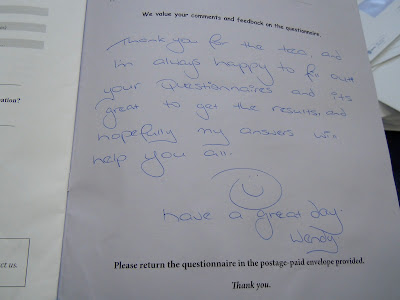
In about another week we'll send a final reminder postcard and that will be the end of that. Completed surveys are still rolling in and we're still getting surveys with fun comments like this:

In case you can't read it, it says:
Thank you for the tea and I'm always happy to fill out your questionnaires and its great to get the results and hopefully my answers will help you all. (smiley face) Have a great day.
-WendyHere's another response that I got a kick out of:

In case you can't tell, the question asks how you would describe your usual rate of eating and she circled "Relatively fast" and added, "I'm a nurse!"
Hopefully, you all are enjoying the updates on the survey as much as I enjoy sharing. Feel free to leave a comment if you have any questions about what we're doing.
Tuesday, May 29, 2012
Christmas Comes Early - Survey Style
Thursday is replacement questionnaire mail out day.
Uuuuugh!
Today, our team spent hours writing in women's names and signing our own (it's strange how my signature changes after writing it 700 times!) on cover letters, blu tacking pens to the cover letters, and matching cover letter ID numbers to replacement surveys. This way, anyone who hasn't returned a survey gets a second chance. For some reason, this was mind numbing work today - usually it doesn't bother me much.
Eventually, we decided to take a break to check the mail and see if we had any returned surveys. There were 42. Yay! So, just to give you an idea of what it's like to be a graduate student collecting returned surveys... there's the initial excitement that we received them and then we get to open them. I'm pretty sure our eyes light up when we open them, just like it's Christmas day.
Today we had one survey that a woman stuck a Post-it note to. It said, "Sorry about the delay with returning this questionnaire, have been on holiday." It's sort of sweet that she wrote the note!
I have decided that opening returned surveys is like opening a box of chocolates - you never know what you're going to get. Sometimes everything is complete. Sometimes answers are missing. Sometimes people answer questions and put an asterisk next to their response with an explanation at the bottom of the page.
My favorite part about checking surveys is looking for comments on the last page. We've read all sorts of interesting comments. For example, one woman who received a $5 note explained that it should be a higher denomination. Some women simply thank us for including them in the sample. Others write paragraphs about their own weight-related struggles.
Here's what one woman wrote to us today:
Uuuuugh!
Today, our team spent hours writing in women's names and signing our own (it's strange how my signature changes after writing it 700 times!) on cover letters, blu tacking pens to the cover letters, and matching cover letter ID numbers to replacement surveys. This way, anyone who hasn't returned a survey gets a second chance. For some reason, this was mind numbing work today - usually it doesn't bother me much.
Eventually, we decided to take a break to check the mail and see if we had any returned surveys. There were 42. Yay! So, just to give you an idea of what it's like to be a graduate student collecting returned surveys... there's the initial excitement that we received them and then we get to open them. I'm pretty sure our eyes light up when we open them, just like it's Christmas day.
Today we had one survey that a woman stuck a Post-it note to. It said, "Sorry about the delay with returning this questionnaire, have been on holiday." It's sort of sweet that she wrote the note!
I have decided that opening returned surveys is like opening a box of chocolates - you never know what you're going to get. Sometimes everything is complete. Sometimes answers are missing. Sometimes people answer questions and put an asterisk next to their response with an explanation at the bottom of the page.
My favorite part about checking surveys is looking for comments on the last page. We've read all sorts of interesting comments. For example, one woman who received a $5 note explained that it should be a higher denomination. Some women simply thank us for including them in the sample. Others write paragraphs about their own weight-related struggles.
Here's what one woman wrote to us today:
Since last time (the previous survey) I was challenged to reflect on my health and weight and realised I'd definitely done the "middle-age spread." Joined WeightWatchers online (no time to go to meetings!) and lost 10kg in 7 months. Have managed to keep it off for 6 months by upping the "walking" exercise. Would now like to try to budge the last 5kg. Thanks to this survey, I've taken some positive steps to improve my health outcomes. Yay!It's moments like this where I am so happy and thankful that I've found a field that I love! Weight management research is definitely going to keep me busy for a long, long time.
Subscribe to:
Posts (Atom)